
Give Away the Razor, Sell the Blade: Inside Gillette’s Century-Long Pricing Playbook
Sony lost roughly $60 on every PlayStation 4 it sold at launch. Amazon prices its Kindle hardware at barely more than cost. Printer manufacturers routinely sell desktop printers for less than it costs to make them. None of this is a mistake. It is a deliberate strategy, and it traces back more than a century to a travelling salesman’s frustration with a dull razor.
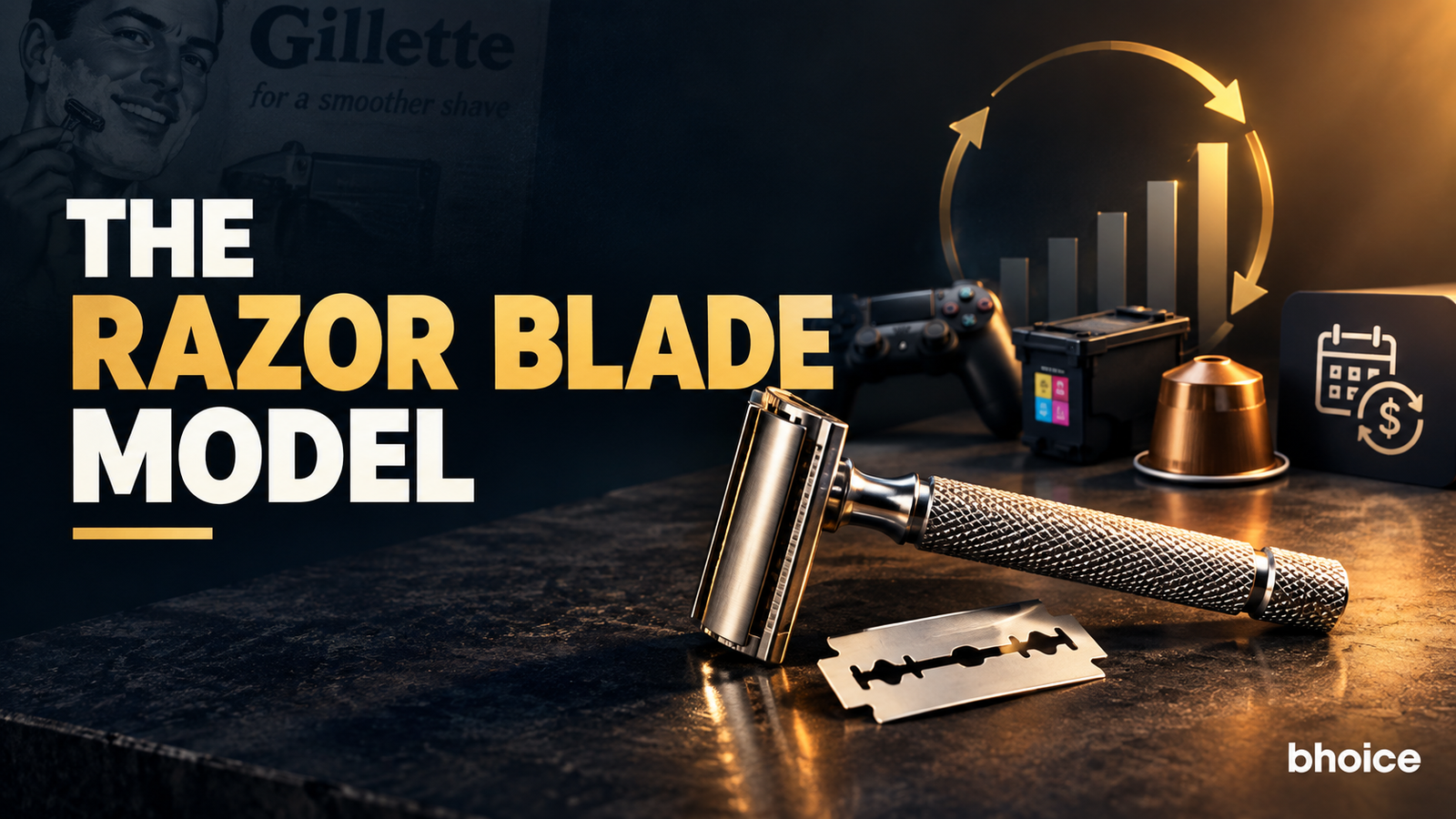
That strategy is known today as the razor blade model: sell the durable good cheap, and make the real money on the consumable that keeps customers coming back for more. It is one of the most cited pricing frameworks in business history, and also one of the most misunderstood. The popular version of the story credits King Camp Gillette with inventing the whole idea from scratch, fully formed, as a single stroke of genius. The real history is slower, messier, and considerably more useful to anyone building a modern hardware or subscription business today.
Where the Idea Actually Came From
At the turn of the 20th century, shaving was a genuinely unpleasant daily chore, and men were stuck choosing between two bad options.
The straight razor was sharp enough to do real damage in unpracticed hands, and required a steady grip and real skill to use safely. Early “safety” razors were an improvement, but their blades were forged from thick steel and needed constant stropping and resharpening just to remain usable. Because home shaving was such a hassle, most men simply avoided it and paid a barber two or three times a week instead.
Gillette, a travelling salesman, kept running into his own dull razor on rushed mornings before sales calls. He eventually arrived at a simple but unusual idea: what if the blade itself were thin, inexpensive, stamped steel, cheap enough to use until it went dull and then throw away entirely, rather than sharpen? Working with an engineer to solve the manufacturing problem of mass producing a thin, disposable blade at scale, he secured a foundational patent for a detachable safety razor system. That patent gave the company a clean 15 year monopoly on the entire category.
Here is the detail the legend usually leaves out. Those original Gillette razors were not cheap loss leaders. They were marketed and priced as a premium, even luxury, grooming product. The now famous formula of selling the handle at a loss and profiting on the blades did not exist yet at launch. It was invented later, under real financial pressure, as a defensive response to a crisis rather than a founding insight.
The Crisis That Forced the Pivot
For fifteen years, Gillette’s patent protection meant effectively no competition, and comfortable margins on both the razor and the blades. Then, in 1921, the original patents expired.
The market reacted almost overnight. Within twelve months, dozens of manufacturers were producing compatible handles and generic replacement blades at a fraction of Gillette’s prices. With no legal barrier left standing, Gillette’s razor sales fell 20 percent in a single year. The company faced a genuine existential decision: compete on price for a hardware product it no longer controlled and likely lose that fight, or fundamentally rethink the economic relationship it had with its customers.
Leadership chose the second path. Gillette began selling the razor handle itself at cost, and in some cases below cost, specifically to remove any hesitation a new customer might feel about buying in. The actual profit moved almost entirely onto the blades, which were engineered and patented so they would fit only Gillette’s proprietary handle design, locking customers into repeat purchases from Gillette alone.
The governing principle, stated plainly inside the company at the time, was: give them the razors, make them come back for the blades.
It worked, and it worked fast. Within twelve months of the pivot, in 1922, Gillette’s razor sales jumped 127 percent, fully reversing the previous year’s collapse and pulling millions of new customers into an ecosystem they would keep paying into for years, often decades.
Why the Model Works: The Psychology Underneath the Pricing
Strip away the marketing language and the razor blade model is really a psychology trick wearing a pricing strategy as a disguise.
A customer who hesitates to pay $50 upfront for a complete grooming kit will happily pay $2 for a handle, and then $1 every few weeks for replacement blades, even when the long run total cost ends up equal to or higher than the original $50. Gillette had, in effect, identified what is sometimes called the customer’s point of maximum reluctance: the single moment in the purchase journey where price sensitivity peaks. By stripping the price down to almost nothing at exactly that moment, and recovering margin later through small, easy to ignore, recurring charges, the company converted a hard upfront decision into a series of trivial ones.
Two structural choices made this durable rather than a short lived gimmick.
Proprietary lock-in. Gillette patented the connector mechanism and the blade geometry itself, not just the razor handle as a whole. This meant competitors could not simply manufacture a blade that happened to fit a Gillette handle, even if they wanted to undercut Gillette on price. The hardware and the consumable were legally welded together.
Continuous feature escalation. As older patents inevitably lapsed over the decades, Gillette kept the competitive moat fresh by launching new, separately patentable innovations. The twin blade arrived in 1971. Over the following decades the company pushed further, eventually reaching four and five blade systems with lubricating strips and pivoting heads, each new design restarting the clock on protected, high margin pricing.
The Pattern Repeats Across Industries
Once the underlying shape of the model becomes visible, it is difficult to unsee it. The same low margin hardware paired with high margin consumable split shows up again and again, across industries that otherwise have nothing in common with each other or with shaving.
Gaming consoles. Console makers routinely sell hardware near cost or at an outright loss, then recover margin on $70 game titles and recurring subscription services such as PlayStation Plus or Xbox Game Pass.
Printers. Desktop printers are famously inexpensive, sometimes sold for less than the cost of the components inside them. Replacement ink cartridges, by contrast, are priced at a significant markup, and by some estimates rank among the most expensive liquids a typical household buys.
Coffee pod systems. Keurig and Nespresso price the brewing machine itself relatively low, treating it as the entry point, while the ongoing single serve pods generate the bulk of long term profit.
E-readers. Amazon prices Kindle hardware close to its manufacturing cost, and earns the real return over time through e-book sales and subscription services tied to the device.
Instant cameras. Fujifilm’s Instax line follows the same logic on a smaller scale. The cameras themselves are inexpensive, while the physical film can cost up to $2 per photo, meaning heavy users spend far more on film over time than they ever spent on the camera.
Nuclear power. The same logic even appears at industrial scale. Reactors are often built and sold near cost, with the utility’s long term profit coming instead from multi year fuel supply contracts.
Across every one of these examples, the underlying arithmetic is identical: total customer value equals a cheap or loss making upfront hardware purchase, plus the sum of every high margin consumable purchase that follows over the life of that hardware.
Where the Model Breaks Down: Three Structural Vulnerabilities
For all its power, the razor blade model carries a structural weakness baked directly into its foundation. It depends entirely on the company’s ability to keep competitors out of the consumable market. The moment that control weakens, even slightly, the entire economic engine can stall very quickly.
1. The patent expiry cliff. Keurig’s original K-Cup patent expired in 2012, and the market responded almost exactly the way it had responded to Gillette in 1921. Generic, cheap replacement pods flooded retail shelves within a short window, and Keurig’s margins on its core consumable collapsed as customer lock-in evaporated overnight. A patent is a temporary wall, not a permanent one, and every company built on this model is quietly running a countdown clock.
2. Feature fatigue and disruption from below. Gillette’s own long term answer to competitive pressure, namely stacking on additional blades and features to justify continued premium pricing, eventually became a liability rather than a defense. Customers grew tired of paying more for what felt like marginal, incremental improvement. That fatigue created an opening for a fundamentally different kind of competitor. Dollar Shave Club and Harry’s built entire businesses around the opposite pitch: simple, honestly priced razors delivered directly to consumers on a subscription, with none of the multi blade complexity or premium markup. By 2018, the pressure had become serious enough that Gillette cut its retail prices to defend its market share. This is a close to textbook example of what the business theorist Clayton Christensen described as disruption from below, where an incumbent’s own profit protecting behavior over time creates exactly the opening a simpler, cheaper competitor needs to enter and grow.
3. Fatal dependence on the old consumable. The starkest cautionary tale in this entire history belongs to Kodak. The company built enormous, reliable profits on essentially the same formula as Gillette for decades: cheap cameras, expensive film, and expensive photo processing chemicals. But that dependence eventually became a trap rather than a strength. Kodak held early digital camera patents and understood, internally, that the underlying technology was coming and would eventually replace film. Yet the company had too much invested in the economics of its existing consumable business to embrace a transition that would directly cannibalize its own most profitable revenue stream. The very company that helped define the razor blade model was ultimately undone by its own unwillingness to disrupt it before someone else did.
Key Numbers at a Glance
| Metric or Event | Impact |
|---|---|
| Gillette’s overall market survival | Over 120 years, spanning multiple economic downturns and two World Wars |
| 1921 patent expiry sales shock | 20 percent decline in razor sales within a single year |
| 1922 post pivot recovery | 127 percent increase in razor sales following the low cost hardware pricing shift |
| Sony PS4 hardware economics | Approximately $60 lost per console sold at launch |
| Microsoft Xbox One X hardware economics | Roughly break even on hardware, with meaningful margin recovered per game sold |
| Fujifilm Instax film economics | Camera priced low; film can cost up to $2.00 per photo over the device’s life |
| Gillette’s 2018 pricing response | Retail blade prices cut to counter direct to consumer subscription competitors |
What the Model Actually Teaches
Stripped of all the historical detail, Gillette’s century long run offers a handful of lessons that hold up well beyond the shaving aisle, and apply directly to modern hardware, software, and subscription businesses.
Find the customer’s point of maximum reluctance, and price around it deliberately. Customers resist a single large upfront cost far more strongly than they resist a series of small recurring costs, even in cases where the recurring costs eventually add up to more money overall. Moving the price to wherever friction is highest changes buying behavior far more effectively than simply lowering the total price ever could.
A cheap front end product is only a real strategy if the back end can be defended. Loss leading hardware only makes financial sense if something concrete actually stops competitors from selling the matching consumable more cheaply than the original manufacturer can. That protection might be a patent, a proprietary connector or format, deep brand loyalty, or high switching costs. Remove that protection, and the loss leader stops being a strategy and simply becomes a loss.
Feature escalation has a ceiling. Continuously adding capability in order to justify higher consumable prices works only until customers stop valuing the added capability more than they value a meaningfully lower price. Past that tipping point, additional features stop defending the business and instead start inviting a simpler, more focused competitor to undercut it directly.
Overpricing the consumable is ultimately self defeating. The entire model depends on customers continuing to feel that the recurring cost is fair and reasonable. Push that price too far, and a company does not just risk losing a single sale. It actively creates the exact customer resentment that a disruptor needs in order to build a credible business case against the incumbent.
Conclusion
Gillette’s story runs from a fifteen year patent monopoly, through an existential one year sales collapse, into a market defining pivot that has now been studied and imitated for over a century. And the company has spent the decades since that pivot defending it against the very same forces that first forced it into existence: patent expiry, price sensitive new entrants, and its own recurring temptation to over engineer the consumable in search of extra margin.
Every company that later borrowed this playbook, from console makers to coffee machine manufacturers to e-reader companies, inherited the same underlying vulnerability along with the same upside. The razor blade model is not simply a clever pricing trick. It is a continuous bet that a company can keep reinventing its competitive moat faster than rivals can tunnel underneath it. Gillette’s own history, including its near misses, shows clearly that this bet has to be placed again and again, indefinitely, or the model eventually turns against the very company that built it.